
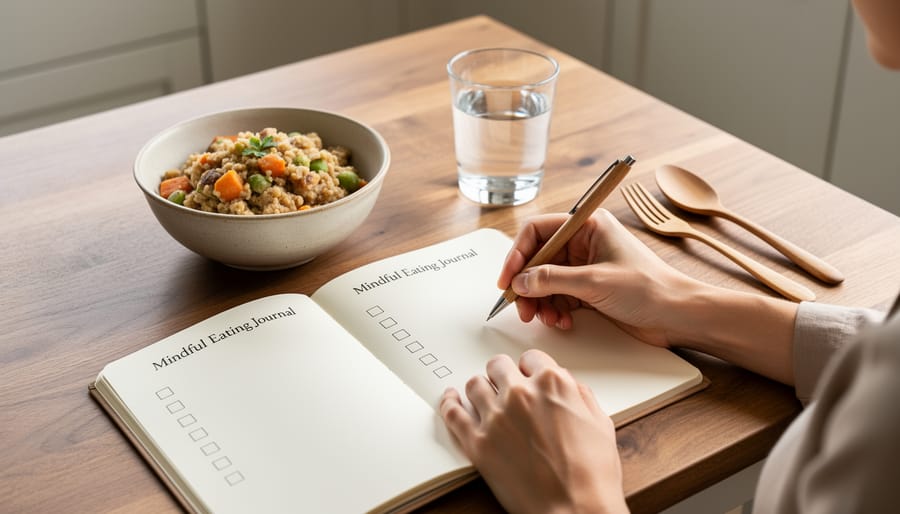
A mindful eating journal is a simple, dedicated space where you record your meals, hunger levels, emotions, and physical sensations before, during, and after eating. This practice rewires your relationship with food by helping you identify emotional triggers, recognize true hunger cues, and break free from restrictive diet mentality that keeps you disconnected from your body’s natural wisdom.
Starting a mindful eating journal takes about five minutes per meal and requires nothing more than a notebook (or notes app) and honest self-reflection. The beauty of this practice lies in its complete lack of rules about what you should or shouldn’t eat. Instead, you’re gathering data about your unique patterns, preferences, and the stories you tell yourself around food.
This approach supports your journey toward body positivity by shifting focus from external validation to internal awareness. You’re not tracking calories or judging portion sizes. You’re exploring questions like: Was I physically hungry when I ate that? How did my body feel twenty minutes later? What emotions came up when I skipped lunch to finish that project?
The journal becomes a mirror reflecting your authentic self and food story without shame or criticism. Over time, these observations reveal patterns you never noticed, like reaching for snacks when stressed about deadlines or eating past fullness at social events. Armed with this self-knowledge, you can make food choices that genuinely honor your body rather than following someone else’s plan.
What You’ll Need to Get Started

The beautiful thing about starting a mindful eating journal is that you probably already have everything you need. This isn’t about buying expensive tools or creating the perfect setup, it’s about choosing what feels right for you.
Your two main options are a physical journal or a digital app. A physical journal gives you the tactile experience of writing by hand, which many women find helps them slow down and connect more deeply with their thoughts. Look for something with enough space to write freely, lined pages work well, but blank pages offer room for creativity. The size matters too: a small notebook fits in your bag for on-the-go entries, while a larger journal at home might feel more inviting for evening reflections.
Digital apps offer convenience and searchability, perfect if you’re always on your phone anyway. Look for apps with customizable prompts and the ability to add notes rather than just tracking numbers. The key is avoiding apps that focus heavily on calorie counting or weight loss metrics, which can shift you away from mindful awareness into restrictive thinking.
Here’s what you might consider having on hand:
- A dedicated journal or notebook (or a notes app on your phone)
- A pen that feels good to write with
- Optional: colored pens, markers, or highlighters for visual organization
- Optional: stickers or washi tape to mark meaningful entries
- Optional: a bookmark or ribbon to quickly find today’s page
These extras aren’t necessary, but they can make the practice feel more personal and joyful. Some women love adding color-coding for different emotions or decorating pages that represent breakthrough moments. Others prefer simple, clean entries. Both approaches are equally valid. The best tool is the one you’ll actually use, whether that’s a gorgeous leather-bound journal or the notes app you open during your lunch break.
Before You Begin: What to Keep in Mind
Before you dive into your mindful eating journal, it’s important to recognize that this practice isn’t one-size-fits-all. If you have a history of disordered eating, an active eating disorder, or find that tracking food, even without numbers, triggers anxiety or obsessive thoughts, this approach may not be right for you at this moment. Calorie tracking may intensify rigidity around food rules, and even well-intentioned reflection can sometimes blur into restriction.
This isn’t about perfection or doing everything “right.” It’s about gentle curiosity and inclusive self-expression that honors where you are today. You might skip days, forget to journal, or write messy, incomplete entries, and that’s completely fine. The goal is awareness and self-compassion, not another rigid system to follow. If you notice your journal entries shifting from “How did I feel during this meal?” to “Did I eat the right amount?”, pause and reassess. This should feel like a supportive conversation with yourself, not judgment in written form.
Your Step-by-Step Journey to Mindful Eating
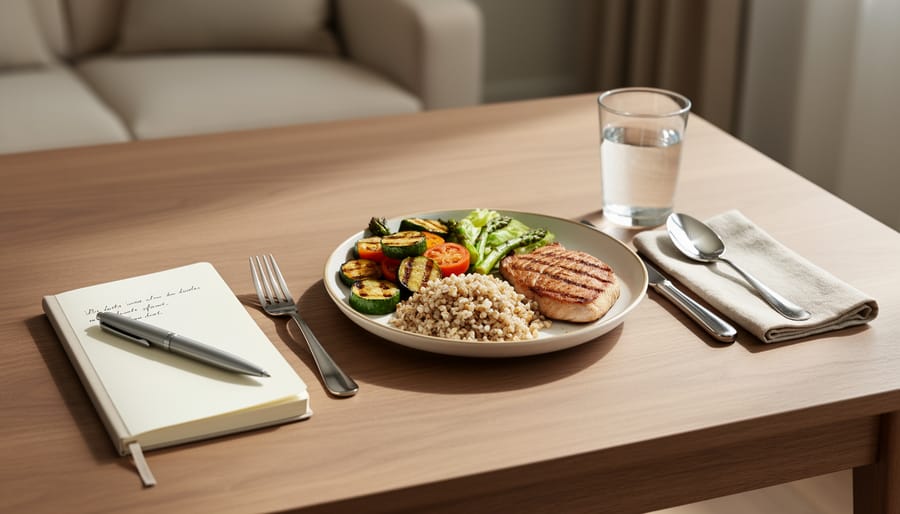
Step 1: Set Your Intention
Before you write a single word in your journal, pause and ask yourself: why am I really doing this? Your intention sets the foundation for your entire practice, and it matters more than you might think.
Resist the urge to default to “I want to lose weight” or “I should eat healthier.” Those goals often come from external pressure rather than genuine self-care. Instead, dig deeper. Maybe you want to actually taste your grandmother’s recipes instead of eating them mindlessly while scrolling. Perhaps you’re tired of post-meal bloating and want to understand what your body is telling you. Or you might crave freedom from the guilt that follows every “forbidden” food.
Write down your true intention in your own words. It could be as simple as “I want to enjoy food again without anxiety” or “I want to honor my hunger instead of ignoring it until I’m starving.” Your why becomes your anchor when the practice feels challenging or when old diet-culture thoughts creep in.
This intention isn’t carved in stone. As you grow through this practice, your why can evolve. That’s not failure, it’s exactly what should happen.
Step 2: Choose Your Prompts
The right prompts transform a blank page into a powerful tool for self-discovery. You don’t need to answer every question with every meal, choose three to five that resonate most with where you are in your journey.
Start with hunger and fullness. Before eating, ask yourself: “On a scale of 1-10, how hungry am I right now?” After your meal, check in again: “What’s my fullness level?” These simple bookends help you reconnect with your body’s natural signals.
Emotional awareness deepens the practice. Try prompts like “What emotions am I feeling right now?” or “Am I eating because I’m hungry, or am I seeking comfort, distraction, or celebration?” There’s no wrong answer here, you’re simply gathering information about yourself.
Physical sensations matter too. “Where do I feel hunger in my body?” “What textures and flavors am I noticing?” “How does my body feel during and after this meal?” These questions ground you in the present moment.
Don’t skip your environment. “Who am I eating with?” “Am I at my desk, on the couch, or at a table?” “What’s the pace of this meal?” Context shapes your eating experience more than you might realize.
Finally, capture satisfaction: “Did this meal feel nourishing?” “What would have made it more enjoyable?” Your answers reveal what truly satisfies you beyond calories or portions.
Step 3: Create Your First Entry
Grab your journal and settle into a quiet moment. You don’t need perfect conditions, just a willingness to be honest with yourself.
Start by jotting down the basics: what you ate, when, and where. Then move beyond the facts. How hungry were you before eating? Rate it on a scale of 1-10. What about afterward, did you feel satisfied, stuffed, or still searching for something?
Here’s what this might look like: “Lunch, 1pm, at my desk. Leftover pasta with vegetables. Hunger level before: 7. I was actually pretty hungry but distracted by emails. Ate quickly without really tasting the first half. Noticed the garlic and basil more toward the end when I slowed down. Fullness after: 6. Feel satisfied physically, but wish I’d stepped away from my screen to enjoy it more.”
Notice how there’s no judgment here, just observation. You’re not labeling choices as “good” or “bad.” You’re simply documenting your experience with gentle curiosity.
If emotions come up while eating, note those too. Stressed? Celebrating? Bored? These insights become your roadmap for understanding your unique patterns with food.

Step 4: Build a Sustainable Routine
The secret to lasting change isn’t perfection, it’s finding a rhythm that fits your real life. Most women find success journaling right after meals, when sensations and emotions are freshest. You’ll need just three to five minutes, not the elaborate ritual you might imagine.
Start with one meal daily. Maybe it’s breakfast on weekdays when you have quiet morning moments, or dinner when you can reflect before evening routines. Choosing the same meal creates a habit anchor your brain recognizes.
For hectic days, try voice memos on your phone during your commute or quick bullet points between meetings. A simple “satisfied, ate while scrolling Instagram, felt rushed” captures valuable insights without demanding precious time. Some weeks you’ll write detailed paragraphs; others, you’ll jot fragments. Both count.
Link your practice to existing habits. Keep your journal next to your coffee maker, tuck it in your work bag, or set a gentle phone reminder after typical meal times. The goal isn’t documenting every bite forever, it’s building awareness that eventually becomes second nature, whether you’re writing it down or not.
Step 5: Reflect and Adjust
After a week or two of journaling, set aside 15 minutes to flip back through your entries. You’re looking for threads, not perfection. Maybe you notice that rushed breakfasts leave you unsatisfied by 10 a.m., or that Saturday dinners with friends feel most nourishing. These patterns are gold, they reveal what your body actually needs.
As you review, celebrate the small victories. Did you pause before eating three times this week? That’s progress. Noticed fullness cues once? Beautiful. This practice isn’t about doing everything right; it’s about learning what feels right for you.
When something isn’t working, maybe certain prompts feel tedious or you’re skipping lunch entries, adjust without guilt. Swap in questions that spark curiosity. Try journaling at different times. Your needs will shift, and your practice should shift with them.
Think of your journal as a conversation with yourself that evolves. What served you last month might need tweaking now. That flexibility is the whole point. You’re building trust with your body, and trust grows through honest, compassionate dialogue, not rigid rules.
How to Know It’s Working (and What Comes Next)
The transformation isn’t always loud or immediate, but you’ll notice it in quieter moments. Maybe you pause before reaching for a snack and realize you’re seeking comfort, not food. Or you finish a meal feeling satisfied rather than stuffed and guilty. These subtle shifts tell you the practice is working.
Watch for these signs your mindful eating journal is creating meaningful change. You recognize hunger and fullness cues more accurately. You eat foods you love without the mental gymnastics of justifying or compensating. Digestive issues that stemmed from eating too quickly or while stressed start improving. You actually taste your food instead of inhaling it while scrolling.
Most women notice initial changes within two to four weeks, though deeper relationship shifts continue unfolding for months. Your body needed years to absorb diet culture messages, so give yourself patience as you unlearn them.
When you recognize these positive patterns, you’re ready to expand. Explore intuitive eating principles that build on your newfound awareness. Consider working with a nutritionist who specializes in mindful eating rather than restrictive diets. Deepen your meditation practice to strengthen the mind-body connection that makes this all possible.
Some women transition from detailed daily journaling to weekly check-ins once the practice becomes second nature. Others continue journaling because they love the ritual. There’s no graduation ceremony here, just an evolving practice that grows with you. The goal isn’t to stop journaling but to internalize the awareness it cultivates until mindful eating becomes your default, not something you have to think about.
Your Questions About Mindful Eating Journals, Answered
How is this different from calorie counting?
Mindful eating journaling focuses on your internal experience, hunger signals, satisfaction, emotions, rather than external numbers. Instead of restricting intake, you’re learning to trust your body’s wisdom and build a more intuitive relationship with food.
What if I forget to journal?
Missing entries doesn’t mean you’ve failed. Simply pick up where you left off without judgment. Even journaling a few times a week can reveal patterns and deepen your awareness.
Can I do this while eating with others?
Absolutely. You can do a quick mental check-in during meals and write your observations afterward. The goal is awareness, not isolation from social experiences.
Do I have to journal every meal?
Not at all. Start with one meal a day, or journal only when something feels noteworthy. This practice should enhance your life, not become another source of pressure.
Remember, your mindful eating journal is a personal tool for growth, not a report card. Some weeks you’ll dive deep into detailed reflections. Other times, a quick sentence captures what you need to remember. The beauty of this practice lies in its flexibility and the self-compassion you extend to yourself along the way. If you’re noticing resistance or triggering feelings when you journal, that’s valuable information too. Honor what your body and mind are telling you, and adjust your approach accordingly.
Your mindful eating journal is more than a record of meals, it’s a compassionate conversation with yourself, a daily practice of tuning into what your body truly needs and honoring those signals without judgment. There’s no finish line here, no perfect way to do this. Some days you’ll write pages, other days just a few words, and that’s exactly as it should be.
What matters is that you’re choosing to listen to yourself in a world that constantly tells women to ignore their hunger, shrink their appetites, and follow someone else’s rules. This practice is an act of rebellion and self-love rolled into one.
Your relationship with food is uniquely yours to shape. Start with one entry, one moment of curiosity about how a meal makes you feel. That single step toward awareness can shift everything.